In OLife, not only are ents manifest objects but each cell is manifest as well. A cell object has a variety of attributes such as its name, position, knowledge of its neighboring cells, the generation it was first occupied, the active ent present, the most recently sleeping ent, buried ents, and more.
As ents arrive in and depart from cells, an ent can interact with a cell in ways that affect these attributes. Such an example in 3D OLife is to assign a cell a height on the landscape. Every time an ent moves into a cell, the height of that cell decreases and thus the landscape is terraformed.
Oscillator patterns remain steady and continuously lower the landscape at their position. Gliders and spaceships dig a trough in their wake. And an exploding pattern wreaks havoc on the otherwise smooth landscape.
A cell can contain a stack of buried ents that were previously sleeping there. When another ent has occasion to sleep in that cell, the currently sleeping ent is buried. As sleeping ents awake and move out, the most recently buried ent is resurrected to a sleeping state.
This supports the OLife goal of minimizing the number of ents that need to exist.
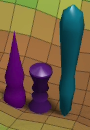
An oscillator “blinker” pattern in the center of the screen – with teal, purple, and violet ents – spins in a circle digging an increasingly deeper hole in the landscape. The outer two ents continue to grow because they are moving.
A glider in the center left – with green, yellow, purple, blue, and violet ents – moves to the upper right and will leave a trough in its wake. All of the ents will grow taller because they are moving, however no ents will be born or die as they move.
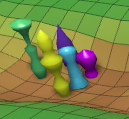
Glider and Blinker
Previous: Musical Life Next: Genetic Stories